Custom Medical Illustration vs Ready-Made Assets: A Research-First Decision Guide
Introduction: Why This Decision Matters More Than It Appears
Medical illustrations are far more than decorative elements to break up blocks of text. In scientific, academic, and clinical contexts, they function as compressed knowledge systems—highly optimized visual representations that translate complex biological processes into clear, interpretable models.
For researchers, clinicians, educators, and biotech professionals, the choice between commissioning a custom medical illustration and licensing a ready-made (pre-designed) visual asset is not merely a budgetary decision. It directly impacts visual fidelity, communication clarity, time to publication, and review outcomes.
1. The Role of Medical Illustration in Scientific Communication
Visuals as Scientific Infrastructure
In modern biomedical work, illustrations serve as core infrastructure across peer-reviewed papers, high-stakes conference posters, competitive grant applications, and biotech investor pitch decks. A meticulously constructed illustration can effectively replace thousands of words of dense methodology.
"Scientifically Informed Fidelity" is Non-Negotiable
Unlike general graphic design, medical illustration operates under strict constraints of biological plausibility. An illustration that is merely "visually appealing" but structurally nonsensical introduces immense risk. The illustration must serve the science first.
2. Understanding Custom Medical Illustration
Custom medical illustration refers to visuals conceptualized and created entirely from scratch, specifically commissioned for a distinct project, proprietary dataset, or highly specific communication goal. While frequently perceived as the definitive "gold standard," that perception requires practical context.
- Precise Alignment With Novel Hypotheses: Often the only viable route for visualizing a brand-new experimental model or unmapped pathway.
- Full Control Over Visual Narrative: Allows authors to dictate framing and seamlessly adapt the artwork to strict journal guidelines.
- The Real Costs (Beyond Price): Industry-standard rates are significant ($5,000 to $20,000+ for 3D conceptualizations). It also introduces briefing delays, feedback loops, and heavy cognitive load for researchers acting as art directors.
3. Understanding Ready-Made Medical Illustration Assets
Ready-made medical illustrations are pre-designed, easily accessible visual assets created to depict common, established scientific concepts, structures, or biological mechanisms. They are frequently dismissed by academics as being "generic" due to poor experiences with mass-market stock platforms, but high-quality scientific assets offer distinct advantages.
- Immediate Availability: Premium ready-made assets completely eliminate production delays.
- Cost Efficiency at Scale: Predictable pricing without per-project commissioning fees allows for long-term reuse.
- Reduced Cognitive Load: Pre-validated, detailed conceptualizations allow researchers to focus mental energy on data rather than micromanaging art direction.
4. The False Dichotomy: Custom vs. Ready-Made
The industry often frames this decision as a rigid binary choice. In practice, high-performing research teams utilize a hybrid approach. Here is the breakdown:
| Decision Criteria | Custom Illustration | Ready-Made Asset |
|---|---|---|
| Scientific Focus | Novel discoveries, proprietary compounds | Established mechanisms, foundational biology |
| Timeline | Flexible (Weeks to Months) | Immediate (Minutes to Hours) |
| Budget | High Investment ($$$$) | Highly Efficient ($) |
| IP / Exclusivity | Strict exclusivity required | Standard licensing acceptable |
5. The Rise of Specialized "Artist-Led" Medical Kits
Generic stock platforms often prioritize volume over visual fidelity, leading to structural errors that undermine research. Common failures include:
- Implausible receptor scaling.
- Oversimplified or stylized membrane topology (e.g., "smooth" cancer cells).
- Misleading or inconsistent color coding.
In response, a powerful third category has emerged: Specialized Medical Illustration Kits.
These high-resolution assets are created by specialized artists who focus exclusively on biological subjects. They offer an ideal middle ground for modern biomedical teams, providing high visual fidelity (vastly superior structural plausibility) with immediate availability and artist-direct pricing.
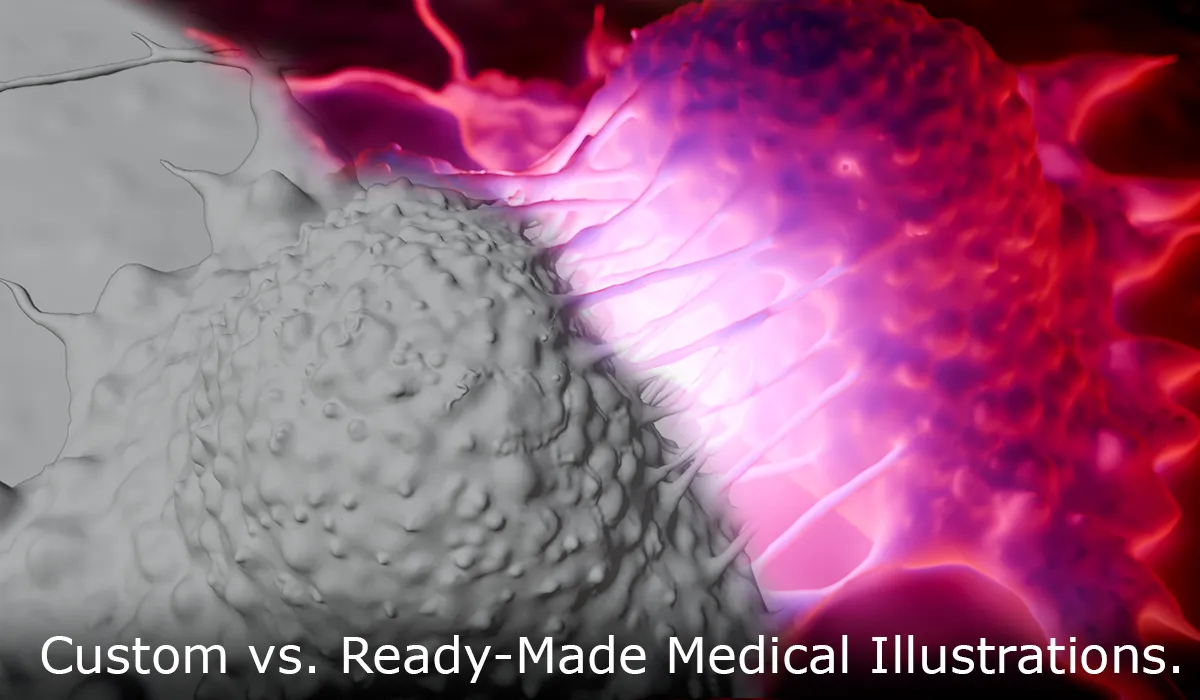
Oncology as a Case Study: Visualizing cancer highlights the limitations of generic approaches. Successfully depicting oncology requires navigating cellular heterogeneity, dynamic signaling environments, and microenvironment complexity. A misleading detailed conceptualization of a cancer cell actively degrades the perceived rigor of the surrounding research.
6. Positioning Kits in a Modern Research Workflow
Counterintuitively, there are times when ready-made assets outperform custom work—specifically when visual standardization across a department is required, or when grant budgets must be strictly allocated to actual experimentation rather than graphics. Without requiring a massive budget, top-tier labs deploy specialized ready-made kits in several ways:
- As baseline visuals to set context in presentations.
- As high-end educational teaching aids for academic lectures.
- As foundational placeholders refined later with specific graphical annotations.
- As structural components integrated into larger, composite journal figures.
7. Licensing, Reuse, and Publication Safety
One of the most overlooked aspects of medical illustration is licensing clarity. Ambiguous licenses introduce legal and ethical risks that can delay publishing. High-quality ready-made assets provide immediate peace of mind by guaranteeing:
- Journal-safe usage for peer-reviewed submissions.
- Conference reuse rights for posters and presentations.
- Educational distribution allowances for academic lectures.
Conclusion: A Decision Grounded in Science
The choice between commissioning custom medical illustrations and licensing premium ready-made assets is entirely a matter of fit for purpose. High-quality research communication demands scientifically informed structural plausibility, clarity of mechanism, workflow efficiency, and ethical licensing reuse.
Rather than asking "Which is inherently better?", the most productive question a biomedical team can ask is: "What does this specific scientific message require to be understood instantly?"
Editorial Note:
PRB Arts focuses on specialized, scientifically informed medical visualization—particularly in oncology and cellular biology—where visual fidelity, structural plausibility, and safe reuse are critical. The perspective presented here reflects current industry-wide practices and is intended to support informed, strategic decision-making across global research, education, and biomedical communication sectors.